Friday, September 30, 2022

That's All She Wrote - One (1) Equation To Rule Them All - Call The Ball

1/11/2011

 In what dimension, at what level, on which fields, can you cooperate and compete? When you're balling like there's no tomorrow, you better call the ball. Ball ๐Ÿcalled: 

 (The Full Rydberg Equation ties together the proton radius and fine-structure constant with the other constants)

One (1) Equation To Rule Them All
#Winning


The Surfer, OM-IV


Sunday, September 11, 2022

Quadratic Equation Solution for $R_H$ - Rydberg Constant

Another thing to note is the Full Rydberg equation can be written as a second order polynomial for the $R_H$ (Rydberg constant) term and then THEREFORE, significantly, one COULD solve for the Rydberg constant using the QUADRATIC equation, treating all other terms as "Known constants" to see if any insight can be gained.  These notes are to keep track of idea for solutions and future blog posts.
Multiply both sides by $R_H$ to clearly see the 2nd order polynomial in $R_H$

$$R_H={{m_ee^4}\over{8\epsilon_0^2h^3c}} - {\pi r_pR_H^2\over{\alpha^2}}$$

$${\pi r_p\over{\alpha^2}}R_H^2+R_H-{{m_ee^4}\over{8\epsilon_0^2h^3c}} = 0$$

This can be used to bridge / map previous $R_H$ to a new $R_H$ that includes the electron to proton mass ratio term that was dropped during the Solid State derivation of the Quantum Theory to show what the correction terms are to the original $R_H$.

Moar later.


Monday, September 5, 2022

New Algorithm Idea - Multi-Variate Polynomial Roots in a Limited Field-ฮจ


ฮจ-The Limited Field being constants. Unknown constants, so they look like variables when they are unknown, however, as constant as ฯ€, ั„, e, 1, or 0, when known.

(Leaving the previously coded algorithm(s*) aside momentarily to discuss this new idea. Again, this is a new idea, not even tested yet, however, it's just like the resistor degenerated (Widlar) bipolar current reference circuit that one iterates to get the value of the current)
Pepe the Frog is the Water Wave
(the energy is in the wave)
More than Global Thinking
moar like Galactic Thinking
(be flexible and flow like water, go with it)
 
Algorithm Description: 
  1. Start with original NIST/CODATA constants' values.
  2. Pick one constant at a time and iterate it until the error** is zero up to the precision of the calculation (16 digits, need to check if more decimal precision is possible). 

  3. Save that as the next new value of the constant.
  4. Chose the next constant, iterate until the error is again zero, save that value.
  5. Do this for all constants until a whole NEW set of values have been obtained, then REPEAT the whole process.
  6. Continue the process and check if the value are converging, diverging, oscillating or varying.
The concept is that the constants' inter-relationship IS defined by the polynomial, so using ALL the best measured values to calculate one, since that one we are interested in, say, the proton radius.  We plug in ALL the NIST/CODATA values, including the one for the proton radius and see that the error is non-zero, so we tweak the proton radius until the error is zero. Then do it for each constant, repeatedly and IF the values converge to a new set of stable constants, then those are the precise theoretical values of the fundamental physics constants.

This likely will work because the value of one of the constants depends upon the value of ALL of the other constants (8 in this case), and using all of the other values to calculate one averages and uses the precision of the equation itself. (proposal)

So, the constant being calculated depends upon all the other constants. If we calculate what each one should be based upon all the others, we get a new value.  This can be done for each constant, and the error plotted for each new set to verify the total error is decreasing. Each set of new constants is one iteration through the error calculation.  With each new set of constants, the error should be getting smaller and smaller. And if repeated with different starting seed values should always converge to the same value independent of starting values (TBD). If so, then this algorithm is clear and clean.

Anyway, simply wanted to describe it since it is so simple.  Then blog through it step by step and build a Goog-colab Python notebook solution old school like the good old days.

Maritime Law Pepe is watching the water agua AguA Ag|uA|Au ๐Ÿœ›๐Ÿ†๐Ÿธ๐ŸŒŠ๐Ÿฆ†...


*original early and mid 90s versions of the algorithm have been lost over time, and the recent version in this blog needs more work
** the full Rydberg polynomial is used for the error equation as when all constants are entered, it should equal 1.00000... and any deviation from unity is error.  Zero error means when the constants are plugged into the Rydberg polynomial, it exactly gives 1.0. (or 0.0 if subtracting 1)
ฮจฮจฮจ - another example of the field of constants: https://phxmarker.blogspot.com/2022/06/richard-feynman-on-fine-structure.html


The Surfer, OM-IV

Wednesday, August 3, 2022

Elana Danaan: DAN WINTER: THOTH, PYRAMIDS, SEEDER RACES AND MYSTERY OF THE NINE EXPLAINED BY SCIENCE ~ AUG-03-2022

Elana Danaan: DAN WINTER: THOTH, PYRAMIDS, SEEDER RACES AND MYSTERY OF THE NINE EXPLAINED BY SCIENCE ~ AUG-03-2022

Monday, August 1, 2022

The Universe is a Feedback System


https://en.wikipedia.org/wiki/Feedback

The Full Rydberg Polynomial (polynomials only include integer powers and no ratios, so the Full Rydberg Polynomial should be rewritten into normal form).  Secondarily, to solve for each unknown, an equal number of equations are needed.  While a single function of "constants" (the polynomial) is not enough equations for a solution, there may be an exception for regions of stability around the physically measured values.  Anyway, that topic will be saved for a later full solution, if possible. 
notes for later:
Roots and coefficients of multivariate polynomials over finite fields
The crucial observation used in the proof of Theorem 1 is that a univariate polynomial F(X) can at most have deg F roots. For multivariate polynomials over general fields there does not exist a similar result as typically such polynomials have infinitely many roots when the field under consideration is infinite. For multivariate polynomials over finite fields, however, we do have a counterpart to the bound used in the proof 

Presently, this post is about the idea of mapping the Rydberg polynomial to the negative feedback system equations.  There is a fairly good chance there is a DIRECT mapping.

If so, this mapping will demonstrate how, as Nassim Haramein has clearly scientifically/theoretically stated and demonstrated that the Universe is a feedback system, the constants such as the fine-structure constant evolve/derive naturally from the wave-equation EM feedback nature of the Universe.

Python learning is going on in parallel.  Python is the tool to use for this kind of work and would have come in helpful earlier on in this blog.  Moar on this in future posts...

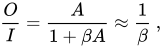
The figure shows a simplified block diagram of a negative feedback amplifier.

The feedback sets the overall (closed-loop) amplifier gain at a value:

where the approximate value assumes ฮฒ>> 1. This expression shows that a gain greater than one requires ฮฒ < 1. Because the approximate gain 1/ฮฒ is independent of the open-loop gain A, the feedback is said to 'desensitize' the closed-loop gain to variations in (for example, due to manufacturing variations between units, or temperature effects upon components), provided only that the gain A is sufficiently large.[32] In this context, the factor (1+ฮฒA) is often called the 'desensitivity factor',[33][34] and in the broader context of feedback effects that include other matters like electrical impedance and bandwidth, the 'improvement factor'.[35]

 So, there may be a clear way to solve the "polynomial" that at first glance has no solution since it's one* equation and 8 unknowns.  By grouping into The Universal Feedback System, perhaps it can be shown once and for all where all these constants come from in a logical, likely geometrical ratioed way.

#Winning

TFW #IAM #Winning

* since the polynomial is derived from a series of equations that are solved simultaneously, implicating the derivation may show/include more than 1 equation... ...this statement is still being verified


from https://subtle.energy/nassim-haramein-the-connected-universe/:

Through nearly 30 years of research in physics and writing multiple papers, Haramein has come to a deep understanding of the underlying mechanics of our universe, using his equations and theory to calculate the most accurate prediction of the charge radius of the proton to date. Bringing in evidence from fundamental physical principles and leading research, he is able to show that we live in a connected universe with an inherent feedback network in the structure of space, which has led to pioneering insights in our interpretation of cosmological, quantum, and biological scale systems.


The Surfer, OM-IV

Wednesday, July 20, 2022

Comments on Programming "The Oracle**"

(Mrs. Hoffman (late) would be proud, after 4 years of Latin...)
(credit: Stoned)

Programming the sign-flip algorithm solution to the full Rydberg polynomial (same polynomial  as mainstream with the re-addition of the proton to electron mass ratio term they dropped, significantly including the proton radius puzzle solution,  - see Foundations of Solid-State reduced mass assumption), in the 90's, I found the convergence was sensitive to implementation. Therefore, breaking the problem into two phases allows for iterative improvements to the sign-flip algorithm if analysis of results require.

A set of solution dataset .csv files for different seed values (and other test cases) can (and is being) be generated and analyzed.

If any convergence problems are found, then iterate a revision/update to the solution phase and repeat stability and uniqueness analysis phase.

Since this is (mostly, except for when higher-level consultation is required with Lyz) a one man band operation, careful defining of the problem step by step slowly evolves into the correct solution. 

Live* blogging works best for tapping into the information... ...the consciousness part.

Over the next few months this is the plan: to create a set of .csv solutions posted online that can be analyzed to verify uniqueness and stability. Using open source programming and solutions.


Python Programmer YouTube channel mentioned the problem with Excel that the data and analysis are too mixed together like I'm saying why I'm using Python and Pandas and other modules now.


*also my excuse for poor English to Mrs. Hoffman! (and explains the many updates/revisions/additions to these blog posts) - LIVE blogging means just going for it showing mistake and all like https://phxmarker.blogspot.com/2015/03/surfers-down-but-not-out.html
**"The Oracle" in this context is TOPPCG: https://phxmarker.blogspot.com/search?q=The+Oracle

The Surfer, OM-IV (ฮฉ4)
©2021 Mark Eric Rohrbaugh & Lyz Starwalker © 2022

Thursday, July 7, 2022

*The Oracle in Python - Colab

Breaking the stability & uniqueness problem into 2 parts:
  1. Solution Phase
    1. Generates constants in .csv - a seperate .csv for each test case
    2. test cases would include varying initial seed values
  2. Analysis Phase
    1. Plotting results 
    2. Verifying converges to same values even with varying seed
A view of the Error and e (Elementary charge) is generated with Colab 
*This blog may contain statements that reflect the opinion of the author
The Surfer, OM-IV

Friday, July 1, 2022

Rydberg Polynomial and Reduced Mass* Error

This says it all

Thursday, June 23, 2022

Future Proves Past (Q’s back)

Present the answer first then show the derivation.  Present the answer then ask the question.  That is the technique used by this blog and other intelligence operations.

June 22, 2022


https://news.google.com/stories/CAAqNggKIjBDQklTSGpvSmMzUnZjbmt0TXpZd1NoRUtEd2l4MEtuQ0JSR2NZdUFhNG5ON05DZ0FQAQ?ceid=US:en&oc=3


Wednesday, June 22, 2022

Excel VBA macro: The Oracle Physics Constants Generator Rev 3.0 - The Oracle - TOPCG_r3p0

This is a work in progress to investigate the uniqueness and stability of the sign-flip solution to the Full Rydberg polynomial for a single electron hydrogen atom at 0K using a MS Excel VBA macro.

The link points to an Excel file with the VBA macro.  Enable macros to run.

  1. Download Excel file (must have MS Excel to run VBA macros) 
  2. Open the downloaded Excel file and enable macros 
  3. Default is set to 8 digits, runs in under a minute (worksheet calculation is off by default)
  4. Once done running , click Formulas -> Calculate sheet to process plots
  5. Scroll to right of data window and pan around to make plots update and click Formulas -> Calculate
3 constants are set as fixed (golden/yellow) and the remainder vary.  

These are initial results.  Uniqueness and stability has not been proven/demonstrated yet.  


screen captures:
TheOracle-TopPCG_rev3p0 initial and golden values at top of file (8 digits accuracy)


Error (8 digits resolution)

The Surfer, OM-IV

Sunday, June 19, 2022

One for Each Constant Sounds Fair


National_Medal_of_Science

&
1 of these
Presidential_Medal_of_Freedom


Awarded for"An especially meritorious contribution to the security or national interests of the United States, world peace, cultural or other significant public or private endeavors."


Saturday, June 18, 2022

2011/2012 PDF: Pohl et al: "Is the proton radius a player in the redefinition of the International System of Units?"

https://www.academia.edu/13513015/Is_the_proton_radius_a_player_in_the_redefinition_of_the_International_System_of_Units

This paper outlines how the constants and pertinent information about the system...

More later.

From the PDF:

"It is now recognized that the International System of Units (SI units) will be redefined in terms of fundamental constants, even if the date when this will occur is still under debate. Actually, the best estimate of fundamental constant values is given by a least squares adjustment, carried out under the auspices of the Committee on Data for Science and Technology (CODATA) Task Group on Fundamental Constants. This adjustment provides a significant measure of the correctness and overall consistency of the basic theories and experimental methods of physics using the values of the constants obtained from widely differing experiments. The physical theories that underlie this adjustment are assumed to be valid, such as quantum electrodynamics (QED). Testing QED, one of the most precise theories is the aim of many accurate experiments. The calculations and the corresponding experiments can be carried out either on a boundless system, such as the electron magnetic moment anomaly, or on a bound system, such as atomic hydrogen. The value of fundamental constants can be deduced from the comparison of theory and experiment. For example, using QED calculations, the value of the fine structure 
∗Author for correspondence (francois.nez@spectro.jussieu.fr). One contribution of 15 to a Discussion Meeting Issue ‘The new SI based on fundamental constants’. 4064 This journal is © 2011 The Royal Society Downloaded from rsta.royalsocietypublishing.org on November 23, 2012 Proton radius to redefine SI units 4065 
constant given by the CODATA is mainly inferred from the measurement of the electron magnetic moment anomaly carried out by Gabrielse’s group. (Hanneke et al. 2008 Phys. Rev. Lett. 100, 120801) The value of the Rydberg constant is known from two photon spectroscopy of hydrogen combined with accurate theoretical quantities. The Rydberg constant, determined by the comparison of theory and experiment using atomic hydrogen, is known with a relative uncertainty of 6.6 × 10⁻¹². It is one of the most accurate fundamental constants to date. A careful analysis shows that knowledge of the electrical size of the proton is nowadays a limitation in this comparison. The aim of muonic hydrogen spectroscopy was to obtain an accurate value of the proton charge radius. However, the value deduced from this experiment contradicts other less accurate determinations. This problem is known as the proton radius puzzle. This new determination of the proton radius may affect the value of the Rydberg constant R∞. This constant is related to many fundamental constants; in particular, R∞ links the two possible ways proposed for the redefinition of the kilogram, the Avogadro constant NA and the Planck constant h. However, the current relative uncertainty on the experimental determinations of NA or h is three orders of magnitude larger than the ‘possible’ shift of the Rydberg constant, which may be shown by the new value of the size of the proton radius determined from muonic hydrogen. The proton radius puzzle will not interfere in the redefinition of the kilogram. After a short introduction to the properties of the proton, we will describe the muonic hydrogen experiment. There is intense theoretical activity as a result of our observation. A brief summary of possible theoretical explanations at the date of writing of the paper will be given. The contribution of the proton radius puzzle to the redefinition of SI-based units will then be examined."

Friday, June 17, 2022

Nassim Haramein on the Radius Of The Proton - "all of a sudden all of standard the standard model QED just goes out the window"

2019 - electron re-measurement of proton radius agrees with muonic measurement verifying proton radius puzzle