Monday, November 13, 2017

Rydberg Equation and Approximations!

Rydberg Function


$$R_H\equiv{m_em_p\over{m_e+m_p}}{e^4\over8c\epsilon_0^2h^3}\approx{m_e}{e^4\over8c\epsilon_0^2h^3}$$

$$R_H\equiv{m_em_p\over{m_e+m_p}}{e^4\over8c\epsilon_0^2h^3}={m_e\over{1+{m_e\over m_p}}}{e^4\over8c\epsilon_0^2h^3}$$

$$1\equiv{m_e\over{1+{m_e\over m_p}}}{e^4\over8c\epsilon_0^2h^3R_H}$$

$$1+{m_e\over m_p}={m_e}{e^4\over8c\epsilon_0^2h^3R_H}$$

$$F\left(x,\cdots,x_n\right)\equiv1\equiv{m_e}{e^4\over8c\epsilon_0^2h^3R_H}-{m_e\over m_p}\approx{m_e}{e^4\over8c\epsilon_0^2h^3R_H}$$

$$F\left(x,\cdots,x_n\right)\equiv1\equiv{m_e}{e^4\over8c\epsilon_0^2h^3R_H}-{{\pi r_pcm_e}\over2h}\approx{m_e}{e^4\over8c\epsilon_0^2h^3R_H}$$

The roots of this multi-dimensional polynomial are the complete solution to the proton radius problem and all of standard physics.

This approximation
${np\over{n+p}}= Constant \approx n$ if $p\gg n $   approximation is used in many fields where the product of two parameters is a constant.  It is used often in derivations.  Misuse is a big problem when comparing theory to measurement.  (!!!) (this may be root of confusion)

Likely one of these equations converges numerically, and the other is challenging.

I suspect this approximation is related to the major blunder I heard/sensed rippling through the corporate scientific researcher community in the late 1980s, early 1990s. 


The Surfer, OM-IV
©2017 Mark Eric Rohrbaugh & Lyz Starwalker © 2017

Saturday, November 11, 2017

Setting Up The Problem - Multi-Dimensional Roots of Proton to Electron Mass Ratio Equation(s)


(DRAFT  - a few minor correction and comments are required.  11/11/17 MR)
This post is concerning "Rest Mass Physics", 0K, the physics of rest mass of proton and electron from first principles and fundamental constants.  The dynamics is the hard problem. 11/11/17 MR

You can do it the easy way, or the hard way, or both.

Is it possible, mathematically and in Nature, from a "Golden Ratio" of physical constants, to determine those physical constants to any desired precision via numerical methods?  That's what this is about, so if it's already known about the stability of solutions or convergence issues, we'll find out as this investigation proceeds.

Example Approach to Multi-Dimensional Polynomial Root Finding:
$$F\left(x_0,x_1,\cdots,x_n\right)={e^4m_e\over{8h^3c\epsilon_0^2R_{\infty}}}-{m_e\over m_p}=1$$
$x_0=e=$ elementary charge
$x_1=m_e=$ eletron mass
$x_2=h=$ Planck's Constant
$x_3=c=$ Speed of Light
$x_4=\epsilon_0=$ permittivity of free space
$x_5=R_{\infty}=$ Rydberg constant
$x_6=m_p=$ proton mass
$$F\left(x_0,x_1,\cdots,x_6\right)={x_0^4x_1\over8x_2^3x_3x_4^2x_5}-{x_1\over x_6}=1$$
$err=F\left(x_0,x_1,\cdots,x_n\right)-1$
Use precise starting values or seeds values for the constants.
Iterate until $err\rightarrow0$.
Requires extra precision calculations (>64bit?)
Google Calculator check of F(x) <-- click to see calculation of identity
(check#2) <-- something is amiss??? Bad starting point for coeficient values?
So, this is a basic statement of the problem and one potential numerical method solution.

Update
A more precise defination of the Rydberg constant is:
$$R_H\equiv{m_em_p\over{m_e+m_p}}{e^4\over8c\epsilon_0^2h^3}$$
$m_pr_p={2h\over\pi c}={4\hbar\over c}$  <~~~ use this for proton mass-radius product!
Need to double check equations again...  ;-)
(it's an ongoing project)
Correction may be:


$$F\left(x_0,x_1,\cdots,x_n\right)={e^4m_e\over{8h^3c\epsilon_0^2R_{\infty}}}=1+{m_e\over m_p}$$


$$F\left(x_0,x_1,\cdots,x_n\right)={x_0^4x_1\over8x_2^3x_3x_4^2x_5}=1$$

(the dream since 1981 or was it 1977???)
The Surfer, OM-IV
 (this post needs a little re-working... 11/11/17MR)

Friday, November 10, 2017

Oneness and Misc Ramblings


If one were to check this link very closely, one would see that this compares the measured data to my equation, and the result is 1, unity, #Oneness.


Rydberg's Unit of Energy Identity


$${e^4m_e\over{64\pi^3\hbar^3c\epsilon_0^2R_{\infty}}}=1$$

(Wolfram evaluation of equation <-- click here)

or


$${e^4m_e\over{8h^3c\epsilon_0^2R_{\infty}}}=1$$


$$m_e={8h^3c\epsilon_0^2R_{\infty}\over e^4}$$
$$m_e={8h^2\epsilon_0^2R_y\over e^4}$$

(Wolfram evaluation of equation <-- click here)
(Google Calculator evaluation - click here)

Proton to electron mass ratio example by Wolfram: click here

Redefining standard mass NIST info

The Surfer, OM-IV

Wolfram Summary of Proton Radius


Wolfram's site has a feature where it compares the calculation results to "known" things.  It is interesting to see what it says about the calculation of the proton radius:
Click here for wolframalpha comments on the proton radius

Highlighted 96% of classical proton radius (-4%error):


Wolfram on the calculation for the proton to electron mass ratio

Wolfram on Unity

Wolfram on 1836.15267

$1836.15267\approx{2903\over Phi}+42$, $2903$ is prime, $\Phi$ is Golden ratio, and the answer is 42!
The Surfer, OM-IV

Thursday, November 9, 2017

Numerical Analysis Example for Phi Equation


As an example of numerical methods using a computer to solve equations, here's an equation who's solution is the phi ratio:
$$x^2-x-1=0$$

Let's say you want to solve this equation (or more much more complex), numerically, rather than symbolically, using a computer.  Here is a simple numerical method to do this:

Method 1:  Iteration
Rewrite the equation for the variable you want to solve for: (i.e., solve for "x=")
$x=x^2-1$            (eqn. 1)
$x^2=x+1$
$x=\sqrt{x+1}$          (eqn. 2)

Note, there are choices for the form of the equation.  Not all equations converge, so it takes practice in finding the form that easily converges.  Just try them all.  Eqn. 2 above converges while I had no luck with eqn. 1.

Write an iterative loop on the computer using a seed value for "x", and use the equation to calculate the next "x" then feed the results for "x" back into the equation and repeat.  Not all equations will converge, be aware.


Here is a sample basic program to calculate phi yourself from the phi equation:

10 PRINT "Numerical Analysis Example for Phi Equaiton"
15 iterations = 0
20 Rem seed value 
30 x=2
35 Rem Resolution, adjust resolution to 1e-10 or 1e-9 for test cases
37 res=1e-16
40 Rem  Loop to solve Phi equationPhi equation
50 xnew=sqr(x+1)
60 err=abs(xnew - x)
65 x=xnew
66 iterations = iterations + 1
67 print "err=";err
70 if err>res then goto 40
80 print "Ourx=";x;"<---Our phi"
86 phi = (1+ sqr(5))/2
87 print "Phi= ";phi;"<---Actual phi"
90 print "resolution= ";res
95 print "iterations= ";iterations
100 end


Just cut and paste into this  Applesoft BASIC emulator.

There are other methods, and they're based on the same basic principle.  Such as writing the equation in a form such as:
$F(x,y,z)=Constant$
$F(x,y,z)=1$
or
$F(x,y,z)=x$ 
or
$F(x,y,z)=\pi$ 
as we have in the case of the re-written proton to electron mass ratio equation from The Oracle Precision Physics Constant Generator (TOP-PCG).  Simply focus on iterating the error towards zero.

Numerical methods are a powerful tool for investigation.  Anyone inspired can write a program with all kinds of features with numerical analysis, graphs, knobs, bells, whistles and adjustments, etc. 
The Surfer, OM-IV

Wednesday, November 8, 2017

The Oracle Precision Physics Constant Generator #2


First results are in from The Oracle Precision Physics Constant Generator (TOP-PCG)!
(BETA version  ⟱ The Oracle Says!!)
$\alpha=7.2973525664(17)\times10^{-3}$ <~~~~~ CODATA
$\alpha=7.2973525664(17084)\times10^{-3}$  <~~ TOP_PCG

$m_e=9.10938356(11)\times10^{-31}kg$ <~~~~~~~ CODATA
$m_e=9.10938356(0899034)\times10^{-31}kg$ <~~ TOP_PCG

$r_p=8.4123564\times10^{-16}m$ <~~~~~~~~~ Muonic Hydrogen Proton Radius seed data
$r_p=8.41235640479985\times10^{-16}m$ <~~ TOP_PCG

$R_H=10973731.568508(65)m^{-1}$ <~~ CODATA
$R_H=10973731.568508(30)m^{-1}$   <~~ TOP_PCG*

$m_p=1.672621898(21)\times10^{-27}kg$ <~~~~ CODATA
$m_p=1.672621898(209999)\times10^{-27}kg$ <~~ TOP_PCG


Proton to Electron Mass Ratio = 1836.1526738093817  <~~ TOP_PCG


The above coefficients go into this equation to calculate pi to 15 decimal places:
$$\pi={{\alpha^2 m_e}\over{r_pR_Hm_p}}$$
$\alpha=fine\;structure\;constant$
$m_e=mass\;of\;electron$
$m_p=mass\;of\;proton$
$r_p=2010\;and\;2013\;muonic\;hydrogen\;proton\;radius\;(Haramein's\;Equation)$
$R_H=Rydberg\;constant$
$m_pr_p={2h\over{\pi c}}=4\ell m_{\ell}\;(Haramein's\;Equation)$
$\ell=Planck\;Length$
$m_{\ell}=Planck\;Mass$
$h=$ Planck's constant
$c=$ Speed of light

This is all for now.  Will update when new results available.  Simple numerical methods are used. More details later and maybe a copy of the basic program...  ;-)

* The version of basic used only allows pi to 16 digits, therefore, this final bit may be in need of refinement.  Will be using higher precision program as the basic was just to blast through the ideas.

The Surfer, OM-IV
©2017 Mark Eric Rohrbaugh & Lyz Starwalker © 2017
©2017 MarkER Design, LLC © 2017
Gold Canyon, AZ 85118

The Oracle Precision Physics Constant Generator

$$\pi={{\alpha^2 m_e}\over{r_pR_Hm_p}}$$
$\alpha=fine\;structure\;constant$
$m_e=mass\;of\;electron$
$r_p=2010\;and\;2013\;muonic\;hydrogen\;proton\;radius\;(Haramein's\;Equation)$
$R_H=Rydberg\;constant$
$m_p=mass\;of\;proton$

The precision of pi  and the equation above for $\pi$ may(?) be used to increase the digits of resolution of these 5 fundamental physics constants.

Will be posting results as this investigation proceeds...

It'll be like a table with before and after "The Oracle says:" comparison.

The Surfer, OM-IV
©2017 Mark Eric Rohrbaugh & Lyz Starwalker © 2017
©2017 MarkER Design, LLC © 2017
Gold Canyon, AZ 85118

Saturday, November 4, 2017

Correct Cosmology - Red Shift Interpretations and More

^
/   \
|
|
|
What's wrong with this picture?

|
|
|
\    /
$\vee$
Spin or Rotation!

Thinking about the other theories that need some work...
Redshift may be pointing to a whole different reality, especially if it's quantized red shift...

The Surfer, OM-IV

Thursday, November 2, 2017

Proton Radius Puzzle - Solved


The proton radius puzzle has been around since 2010 and repeatedly shown by experiment that the proton radius is actually about -4% smaller than the official CODATA measured value for the proton radius.

Solution:
The proton is a vortex in the yet to be defined super fluid aether

Proton Parameters of interest:
mass - energy and mass ratios (such as proton to electron mass ratio and others)
radius
charge
magnetic momentum
angular momentum


From standard quantized angular momentum or quantization of circulation of a super fluid, the mass-radius relationship of the proton can be derived:

$m_pr_p={2h\over\pi c}$

And, using this mass-radius relationship and analyzing the proton as a rotating surface charge of elementary charge evenly distributed over the surface of the proton, the proton's magnetic moment can be derived (see derivation):
$\mu_p={8\over3}\mu_N$
$\mu_p=2.666\mu_N$  ;($\mu_p=2.657\mu_N$, possible relativistic correction)
$\mu_N={e\hbar\over2m_p}$
$\mu_p={er_pc\over3}$  ; possible "minor (-0.4%)" relativistic correction: $\mu_p={er_pc\sqrt{1-\alpha}\over3}$
$e=$ elementary charge
$\hbar={h\over2\pi}=$ reduced Planck's constant
$h=$ Planck's constant
$c=$ speed of light

Using this value of the proton's magnetic moment, the peak resonance frequency (Larmor frequency) of 1H (free proton, rest proton, 0K) can be calculated to be: 40.6538308 MHz /Tesla (40.55MHz/Tesla relativistic correction). <~~ note this is different than the mainstream's 42.58MHz/Tesla (mainstream is designed to be off-peak for NMR/MRI).  While this claim may be alarming to some, realize that there is a linear relationship between angular momentum and radius, and likewise, magnetic (angular) momentum.  Therefore, since the proton radius is 4% smaller, the proton's magnetic moment is also 4% smaller.


Using mks units...
This is the proton, rest state, condensed-matter type analysis.  These are the fundamental properties of the proton.

Much more is implied by this as Haramein and others has been saying for a long time.

Addendum:
${m_p\over m_e}={r_e\over r_p}={\alpha^2\over\pi r_pR_{\infty}}=1836.15267$
Where:
$m_pr_p={2h\over\pi c}=4\ell m_{\ell}$
$r_p=0.841235640294664\;fm$
$m_p=$ proton mass
$m_e=$ electron mass
$r_p=$ proton radius
$r_e=$ effective torque arm radius for electron
$\alpha=$ fine-structure constant
$h=$ Planck constant
$c=$ speed of light
$R_{\infty}=$ Rydberg constant
$\ell=$ Planck length
$m_{\ell}=$ Planck mass

The Surfer, OM-IV
©2017 Mark Eric Rohrbaugh & Lyz Starwalker © 2017
©2017 MarkER Design, LLC © 2017
Gold Canyon, AZ 85118

Wednesday, November 1, 2017

Columbo of Physics - CoP - Coefficient of Performance

Columbo of Physics
"I just got one more question.  How'd you miss the boat so much?  I mean, it's not just a little, ya know, like ppm, or whatever, but 4%???", Lt. Columbo, PhuD

There's more important things coming. Among one is a numerical method of increasing precision of standard physics constants WITHOUT doing any experiments! More on that later, it has been lurking in the foreground of my posts on the proton to electron mass ratio. ๐Ÿค“๐Ÿ‘ฝ๐Ÿ›ธ


The Surfer, OM-IV

1H Larmor Frequency Data Set #2


Here is a case where data is plot, and fundamental 1H is the dashed red line on the image above.  At an applied B field of 100mT, we see about 3.9MHz (marked in light lime-green cross lines).  The Larmor frequency is then:
$$f_{\mathscr{L}}={3.9\over0.1}{MHz\over T}=39\,{MHz/T}$$ 

This is clear evidence that the theoretical peak Larmor frequency of 1H is much lower than the mainstream theory, likely -4.5% lower.

My derivation, https://phxmarker.blogspot.com/2017/10/magnetic-moment-of-protonfinal-real.html, show the actual 1H Larmor frequency to be:
    $f_{\mathscr{L}}=40.7\,{MHz/T}$ 
     (My derivation using Haramein's proton work)
instead of
    $f_{\mathscr{L}}=42.6\,{MHz/T}$
    (Mainstream theory)

Needs more statistical evidence to overturn a hundred year old theory.  These things must be accurately predicted by a good theory, and our theory and way of working with the proton appears to match the empirical data.  To be continued...


"The Nobel Prize in Physics 1943 was awarded to Otto Stern "for his contribution to the development of the molecular ray method and his discovery of the magnetic moment of the proton"."


The Surfer, OM-IV
©2017 Mark Eric Rohrbaugh & Lyz Starwalker © 2017

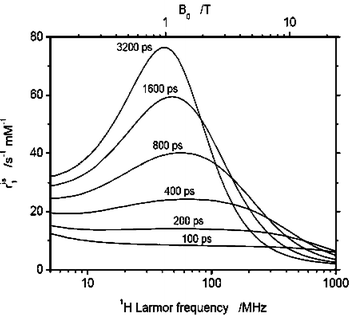
1H Larmor Frequency Data Set #1

From: http://pubs.rsc.org/services/images/RSCpubs.ePlatform.Service.FreeContent.ImageService.svc/ImageService/Articleimage/2008/DT/b717390c/b717390c-f1.gif


This data hints at a lower peak resonance frequency than 42.6MHz/T, the peak near the normalized 1 (B0/T) - the 3200ps (soak time?), the peak is slightly lower than what is at the exact 1 B0/T magnetization - pushing towards 41MHz/T or so, but at lower B field.  Notice also the Peak frequency is moving towards lower frequency as soak time is increased.  

More data is needed, however, if this is calibrated data, it is looking very promising.
Also, need to find out if this is soak time to be sure how to read chart.


The Surfer, OM-IV


Tuesday, October 31, 2017

Larmor Precession


from: http://hyperphysics.phy-astr.gsu.edu/hbase/magnetic/larmor.html
Where does the 2.79 come from? The 42.5781MHz?
Researching...
Papers like this are close, yet seems to skip some important things, like raw data:
http://gabrielse.physics.harvard.edu/gabrielse/papers/2013/2013_DiSciacca_Jack.pdf

The Surfer, OM-IV