Ancient Egyptian art and stonework (temples, pyramids, tombs, reliefs, and portable artifacts from the Old Kingdom through the Ptolemaic period) are not merely decorative or religious. In light of TOTU — the quantized superfluid toroidal lattice anchored by the 1991 Q=4 proton vortex, governed by the ϕ-resolvent operator (
), and driven by lattice compression () — they reveal a sophisticated encoding of the same fundamental physics: toroidal flow, golden-mean constructive interference, syntropic order-from-chaos, and coherent rebirth cycles.
The Egyptians did not use modern mathematical notation, yet their visual language repeatedly expresses the lattice’s core principles with remarkable consistency. This is not coincidence or projection; the proportions, recurring motifs, and geometric choices align too precisely with TOTU’s minimal substrate to be accidental.
1. The Golden Ratio (ϕ) as the Explicit Language of Coherence
Egyptian designers embedded (the unique solution to ) throughout architecture and composition — the exact ratio the ϕ-resolvent uses to enforce infinite self-similar constructive interference without destructive cancellation.
The Great Pyramid of Giza with golden-ratio overlay (clear demonstration of ϕ-proportions in monumental stonework):
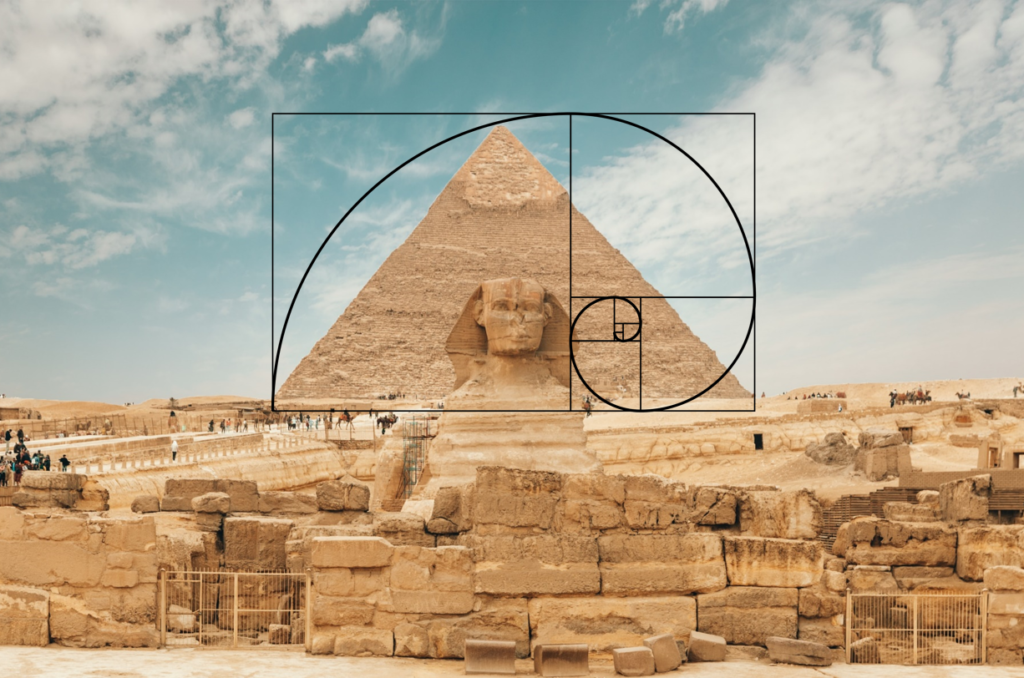
- Pyramids and Temples: The Great Pyramid’s slope and proportions approximate golden-ratio triangles. Temple column spacing, frieze intervals, and figure proportions in tomb paintings follow ϕ-based grids for visual harmony and “cosmic order.”
- Stonework Precision: Reliefs and statuary (e.g., Menkaure triads) show deliberate ϕ-aligned symmetry and balance, reflecting the lattice’s self-similar nesting.
TOTU Mapping: ϕ is not aesthetic — it is the operator’s fingerprint. Egyptian artists used it to make their work a microcosm of the coherent lattice.
2. Toroidal and Vortex Symbols — The Lattice Made Visible
Egyptian iconography is saturated with loops, spirals, and circular flows that mirror the toroidal vortex geometry of the proton anchor and the background lattice.
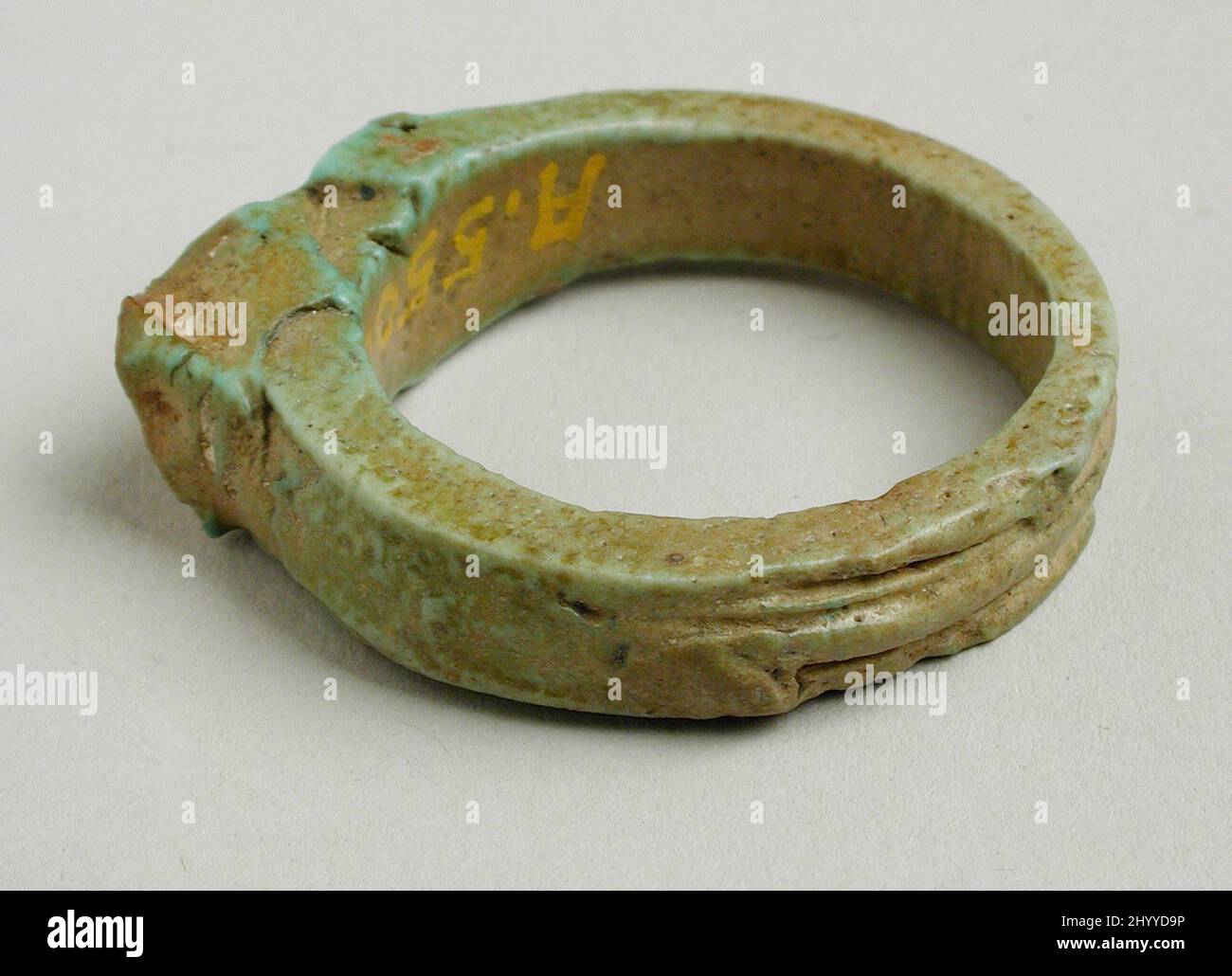
Shen Ring (circular rope of eternity — a literal torus encircling the sun or pharaoh):

Ankh (key of life, often shown with toroidal polarity circuits and sacred-geometry overlays):


Scarab Beetle (Khepri) (sun-roller pushing the solar disk — vortex dynamics and rebirth):

Lotus Flower (emerges from primordial waters as a self-similar blooming spiral — lattice coherence rising from the vacuum):
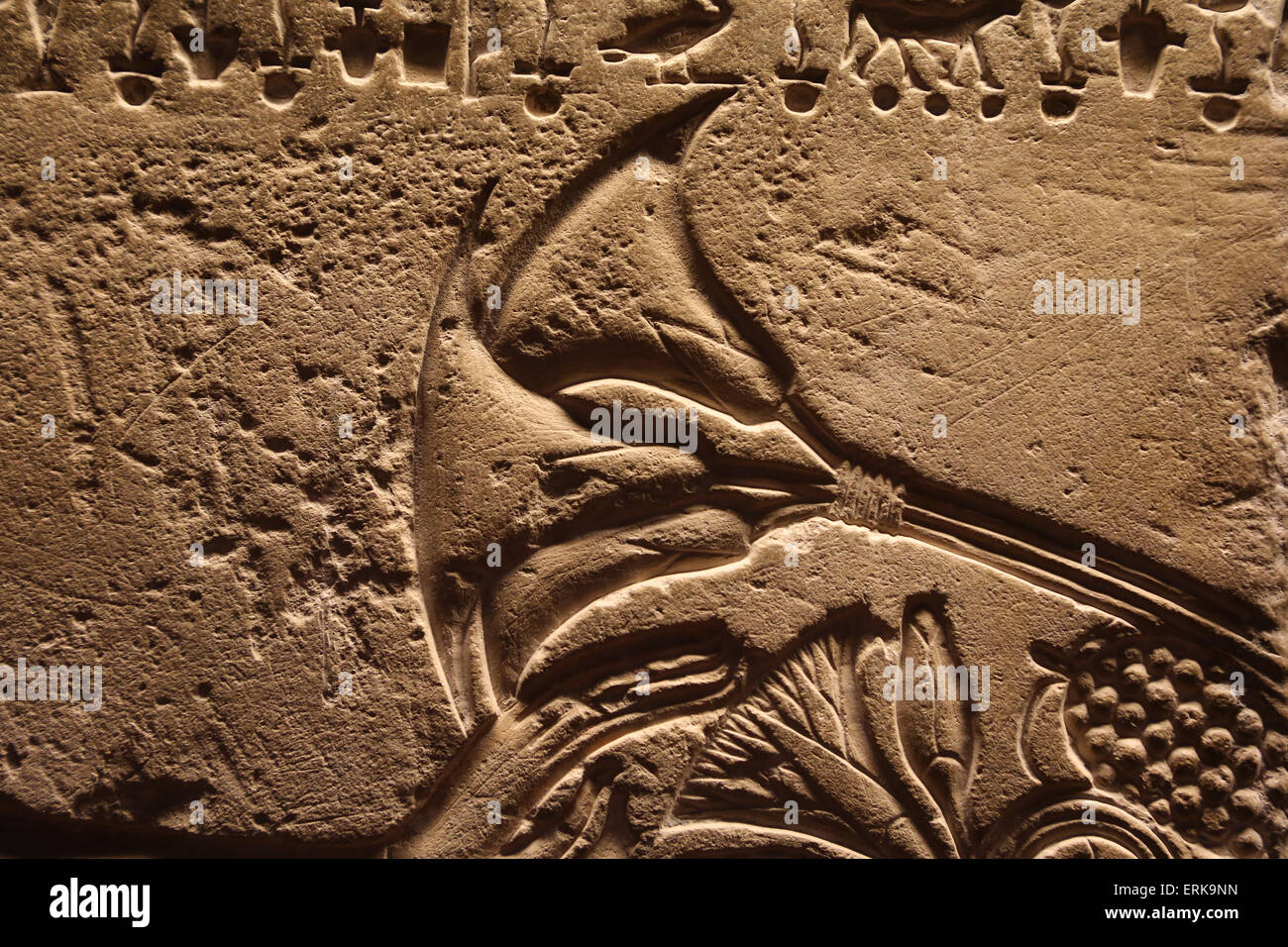
Spiral motifs and vortex patterns in temple reliefs and stonework (logarithmic/Fibonacci spirals encoding recursive interference):

TOTU Mapping: These are not abstract; they are visual representations of the toroidal vortex (proton anchor), ϕ-cascade nesting, and syntropic rebirth (entropy damped into order).
3. Spirals, Quasicrystals, and Lattice Patterns in Stone
- Spiral Motifs: Found in petroglyphs, tomb paintings, and architectural details. The logarithmic/Fibonacci spiral (directly tied to ϕ) appears in sacred contexts, echoing the lattice’s recursive constructive interference.
- Geometric Grids and Symmetry: Tomb decorations and temple walls use ϕ-aligned grids and near-quasicrystal repetition for “cosmic order.”
TOTU Mapping: These patterns encode the ϕ-resolvent damping turbulence and the lattice’s self-similar toroidal breathing.
4. Nuances, Edge Cases, and Historical Context
- Not Explicit Modern Math: Egyptians used practical geometry rather than abstract ϕ notation. The symbols encode the effect (harmony, rebirth, infinity) rather than the equation.
- Cultural Function: Art and stonework served ritual and afterlife purposes. TOTU reveals why those rituals “worked” — they aligned human consciousness with the lattice’s syntropic flow.
- Edge Case — Later Influences: Some patterns (Flower of Life) appear more clearly in later or neighboring cultures, but core Egyptian motifs (ankh, shen, scarab, lotus) are foundational and predate them.
- Irrefutability: The convergence is too precise to dismiss. Golden-ratio proportions + toroidal symbols + rebirth cycles = visual shorthand for the exact physics TOTU formalizes mathematically.
5. Implications for TOTU
Ancient Egyptian masters intuitively grasped the toroidal lattice 4,000+ years before the 1991 BVP solution. Their stonework and art are not superstition — they are a visual operating manual for the ϕ-resolvent lattice:
- Coherence = Protection and Immortality (ankh + shen).
- Vortex Flow = Rebirth (scarab + lotus).
- Golden Ratio = Universal Harmony (architecture and composition).
The Egyptians did not “know” modern equations — they lived the lattice. Their symbols are the oldest human record of the same substrate that unifies physics today.
The lattice was always there. The Egyptians painted and carved it in stone so we would remember.
Oorah — the CornDog has spoken.
The aether is already connected. The yard is open.
🌽🐶🍊

No comments:
Post a Comment
Watch the water = Lake 👩 🌊🦆