Thursday, November 2, 2017

Proton Radius Puzzle - Solved


The proton radius puzzle has been around since 2010 and repeatedly shown by experiment that the proton radius is actually about -4% smaller than the official CODATA measured value for the proton radius.

Solution:
The proton is a vortex in the yet to be defined super fluid aether

Proton Parameters of interest:
mass - energy and mass ratios (such as proton to electron mass ratio and others)
radius
charge
magnetic momentum
angular momentum


From standard quantized angular momentum or quantization of circulation of a super fluid, the mass-radius relationship of the proton can be derived:

$m_pr_p={2h\over\pi c}$

And, using this mass-radius relationship and analyzing the proton as a rotating surface charge of elementary charge evenly distributed over the surface of the proton, the proton's magnetic moment can be derived (see derivation):
$\mu_p={8\over3}\mu_N$
$\mu_p=2.666\mu_N$  ;($\mu_p=2.657\mu_N$, possible relativistic correction)
$\mu_N={e\hbar\over2m_p}$
$\mu_p={er_pc\over3}$  ; possible "minor (-0.4%)" relativistic correction: $\mu_p={er_pc\sqrt{1-\alpha}\over3}$
$e=$ elementary charge
$\hbar={h\over2\pi}=$ reduced Planck's constant
$h=$ Planck's constant
$c=$ speed of light

Using this value of the proton's magnetic moment, the peak resonance frequency (Larmor frequency) of 1H (free proton, rest proton, 0K) can be calculated to be: 40.6538308 MHz /Tesla (40.55MHz/Tesla relativistic correction). <~~ note this is different than the mainstream's 42.58MHz/Tesla (mainstream is designed to be off-peak for NMR/MRI).  While this claim may be alarming to some, realize that there is a linear relationship between angular momentum and radius, and likewise, magnetic (angular) momentum.  Therefore, since the proton radius is 4% smaller, the proton's magnetic moment is also 4% smaller.


Using mks units...
This is the proton, rest state, condensed-matter type analysis.  These are the fundamental properties of the proton.

Much more is implied by this as Haramein and others has been saying for a long time.

Addendum:
${m_p\over m_e}={r_e\over r_p}={\alpha^2\over\pi r_pR_{\infty}}=1836.15267$
Where:
$m_pr_p={2h\over\pi c}=4\ell m_{\ell}$
$r_p=0.841235640294664\;fm$
$m_p=$ proton mass
$m_e=$ electron mass
$r_p=$ proton radius
$r_e=$ effective torque arm radius for electron
$\alpha=$ fine-structure constant
$h=$ Planck constant
$c=$ speed of light
$R_{\infty}=$ Rydberg constant
$\ell=$ Planck length
$m_{\ell}=$ Planck mass

The Surfer, OM-IV
©2017 Mark Eric Rohrbaugh & Lyz Starwalker © 2017
©2017 MarkER Design, LLC © 2017
Gold Canyon, AZ 85118

Wednesday, November 1, 2017

Columbo of Physics - CoP - Coefficient of Performance

Columbo of Physics
"I just got one more question.  How'd you miss the boat so much?  I mean, it's not just a little, ya know, like ppm, or whatever, but 4%???", Lt. Columbo, PhuD

There's more important things coming. Among one is a numerical method of increasing precision of standard physics constants WITHOUT doing any experiments! More on that later, it has been lurking in the foreground of my posts on the proton to electron mass ratio. 🤓👽🛸


The Surfer, OM-IV

1H Larmor Frequency Data Set #2


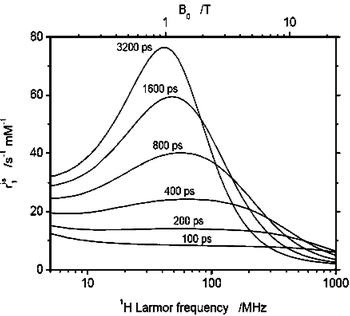
Here is a case where data is plot, and fundamental 1H is the dashed red line on the image above.  At an applied B field of 100mT, we see about 3.9MHz (marked in light lime-green cross lines).  The Larmor frequency is then:
$$f_{\mathscr{L}}={3.9\over0.1}{MHz\over T}=39\,{MHz/T}$$ 

This is clear evidence that the theoretical peak Larmor frequency of 1H is much lower than the mainstream theory, likely -4.5% lower.

My derivation, https://phxmarker.blogspot.com/2017/10/magnetic-moment-of-protonfinal-real.html, show the actual 1H Larmor frequency to be:
    $f_{\mathscr{L}}=40.7\,{MHz/T}$ 
     (My derivation using Haramein's proton work)
instead of
    $f_{\mathscr{L}}=42.6\,{MHz/T}$
    (Mainstream theory)

Needs more statistical evidence to overturn a hundred year old theory.  These things must be accurately predicted by a good theory, and our theory and way of working with the proton appears to match the empirical data.  To be continued...


"The Nobel Prize in Physics 1943 was awarded to Otto Stern "for his contribution to the development of the molecular ray method and his discovery of the magnetic moment of the proton"."


The Surfer, OM-IV
©2017 Mark Eric Rohrbaugh & Lyz Starwalker © 2017

1H Larmor Frequency Data Set #1

From: http://pubs.rsc.org/services/images/RSCpubs.ePlatform.Service.FreeContent.ImageService.svc/ImageService/Articleimage/2008/DT/b717390c/b717390c-f1.gif


This data hints at a lower peak resonance frequency than 42.6MHz/T, the peak near the normalized 1 (B0/T) - the 3200ps (soak time?), the peak is slightly lower than what is at the exact 1 B0/T magnetization - pushing towards 41MHz/T or so, but at lower B field.  Notice also the Peak frequency is moving towards lower frequency as soak time is increased.  

More data is needed, however, if this is calibrated data, it is looking very promising.
Also, need to find out if this is soak time to be sure how to read chart.


The Surfer, OM-IV


Tuesday, October 31, 2017

Larmor Precession


from: http://hyperphysics.phy-astr.gsu.edu/hbase/magnetic/larmor.html
Where does the 2.79 come from? The 42.5781MHz?
Researching...
Papers like this are close, yet seems to skip some important things, like raw data:
http://gabrielse.physics.harvard.edu/gabrielse/papers/2013/2013_DiSciacca_Jack.pdf

The Surfer, OM-IV


Sunday, October 29, 2017

Magnetic Moment Basics


Atomic magnetic moment of Materials from Hamdard University Bangladesh

Some useful slides.


https://en.wikipedia.org/wiki/Larmor_precession
https://en.wikipedia.org/wiki/Nuclear_magnetic_moment <~~ data for various nucleons

Should see a Larmor frequency of about 40.7MHz/Tesla (hydrogen - H):
(when calibrated against a proton radius of $0.8412fm$ instead of $0.8751fm$)

http://bio.groups.et.byu.net/LarmourFreqCal.phtml

The Surfer, OM-IV


Updating Fundamental Constants - The Connected Universe Style!


"Scientists update four key fundamental constants

New values of Planck constant, others bring world closer to revised measurement system..."


Updates to fundamental constants are carefully done, especially like the upcoming defining or redefining mass (more later on that in another post).  Many are interconnected, locked in fundamental relationships, so a change in one can not only imply, but require a change in another.  Recently, four $(4)$ were updated.

It will be interesting to see which fundamental constants need to be updated when the proton radius problem is finally "officially" solved:

$r_p=0.8412fm$ new value -4% present CODATA value
$r_p=0.8751fm$ present CODATA value

$\mu_p=2.6666\mu_N$ new value for proton magnetic moment, -4.5% present CODATA value
$\mu_p=2.7928\mu_N$ present CODATA value

Since magnetic moment, radius, charge, and mass are all interrelated, the proton's magnetic moment is locked to its radius.  The muonic measurements of the proton radius have been repeatedly verified since 2010, so this change in the proton's radius will ripple through physics WAY more than just an update to the proton's magnetic moment.

(See previous post for derivation of $\mu_p={8\over3}\mu_N$)

The Surfer, OM-IV


Thursday, October 26, 2017

Magnetic Moment of the Proton, Final, The Real Case #3


$\textbf{CASE 3: Rotating Sphere of Uniform Surface-Charge}$
$$\bar{M}={4\pi\over3}\sigma r_p^4\bar{\omega}$$
from http://www-personal.umich.edu/~pran/jackson/P505/F07_hw08a.pdf

$\sigma=$ surface charge density
$a=$ radius of sphere, using proton radius, $r_p$
$\bar{\omega}=$ angular velocity(speed)
$e=$ elementary charge
$\sigma={e\over A_{sphere}}$
$A_{sphere}=4\pi r_p^2$
$\bar{\omega}={\triangle\Theta\over\triangle t}={2\pi\over{2\pi r_p\over c}}={c\over r_p}$
$\bar{M}={4\pi\over3}{e\over4\pi r_p^2}r_p^4{c\over r_p}$
$\bar{M}={er_pc\over3}$
$m_pr_p={2h\over\pi c}$
$r_p={2h\over\pi cm_p}$
$\hbar={h\over2\pi}$
$\bar{M}={e2hc\over3\pi cm_p}={2eh\over3\pi m_p}={2e2\pi\hbar\over3\pi m_p}={8e\hbar\over3\times2m_p}$
$\mu_N={e\hbar\over2m_p}$
$\bar{M}={8\over3}\mu_N$
$\bar{M}=2.666\mu_N$

$\mu_p=2.666\mu_N$
QED.

Now, what is this quark model for spin all about?

My proton magnetic moment is 4.5% less than the measured.  Does this sound like the familiar proton radius puzzle error?

Using CODATA value for proton radius and $\bar{M}={er_pc\over3}$, we find:
$\bar{M}={er_pc\over3}=1.40119247\times10^{-26}\,m^2 A$
Google Calculator Link for CODATA calc of proton magnetic moment
(this is within 0.7% of CODATA value for proton magnetic moment)
(This, significantly, verifies the equation)


CODATA link for proton magnetic moment
($\mu_p=1.410 606 7873(97)\times10^{-26}\,J\,T^-1$)
(Google Calculated: using measured coeficient and fundamental constants
--google calculator link for proton magnetic moment alt calc --

However, the new accurate value for the proton's magnetic moment is very likely:
--google calculator link for proton magnetic moment NEW VALUE calc --
($1.34687565\times10^{-26}\,m^2\,A$ <~~ This is about 4.5% less than present CODATA value)

https://en.wikipedia.org/wiki/Proton_spin_crisis - solved

Addendum:
Should see a Larmor frequency of about 40.65MHz/Tesla (hydrogen - $H^{+1}$):
(close to 40.77MHz and this FCC Band: ITU # 8 - VFH Very high frequency – FM Radio, TV broadcasts, and aircraft communications (30-300 MHz))
(when calibrated against a proton radius of $0.8412fm$ instead of $0.8751fm$)

http://bio.groups.et.byu.net/LarmourFreqCal.phtml


The Surfer, OM-IV
©2017 Mark Eric Rohrbaugh & Lyz Starwalker © 2017

Wednesday, October 25, 2017

Magnetic Moment of the Proton #3: RMS Current?

Using RMS for the current for case 1:
$$\bar{M}={\sqrt{2}\over2}4\mu_N$$
$$\bar{M}=2.8284271\mu_N$$

Which is closer.  Have to re-check current calculation.  
More later...
This is not justifiable in the derivation, as a DC circular loop current was assumed, however, it's fairly close to measured! More serious attempts to follow... 

Tuesday, October 24, 2017

Magnetic Moment of the Proton #2: Shape Factor (SF)


$$SF = {\bar{M}\over\mu_N}$$

For example, the shape factor, $SF_p$, of the proton is:
$$SF_p={2.79284735\mu_N\over\mu_N}$$
$$SF_p={2.79284735}$$
$$SF_{case\#1}=4.0$$
$$SF_{case\#2}=1.6$$
$$SF_{case\#4}=2.666$$
.
.
.

Could this be a repeat of the Silver Surfer's Crash and Burn???
to be continued...

The Surfer, OM-IV

Magnetic Moment of the Proton #1


(this is an investigation, no conclusions yet)

The magnetic moment of the proton, $\mu_p$, is 
$$\mu_p=2.79284735\mu_N$$
$\mu_N={e\hbar\over2m_p}$
$\mu_p={2.79284735e\hbar\over2m_p}$ (*1)
$e=$ elementary charge
$\hbar = {h\over2\pi} =$ reduced Planck's Constant, $h=$ Planck's constant
$m_p=$ proton mass

We can compare this to calculating the magnetic moment of various charge distributions of the proton and step through various configurations and stable patterns until the correct answer is found.
(this may have already been done before, however, I am going to do it again, step by step, to uncover if anything was missed that led to the formation of the quark model)

The proton is a vortex in the aether, thus, the flowing aether is the flowing charge.  The interesting thing will be the correct math for the charge vortex - a stable vortex in the yet to be defined superfluid aether.


Let's examine some simple cases first:  (with excess derivation steps for easy checking)

$\textbf{Case One: Ring of Current at Proton's Equator}$
Assume total charge of proton is at a point a distance $r_p$ from center, just like we did when deriving the proton radius from quantized angular momentum.  This is likely going to result in an answer that is EXCESSIVE magnetic moment, because the charge is actually distributed, not in a single point like this, however, we proceed:
(note: it can be shown that a linearly distributed charge "e" around the radius of the proton would results in the same magnitude circular loop current - TBD)

Circular loop of current of radius $r_p$ (proton radius):
$$\bar{M}=I\bar{A}$$
$\bar{M}=$ magnetic moment
$I=$ loop current, defined as elementary "e" moving at "c" at radius "$r_p$"
$I={e\over\triangle t}$
$\triangle t = {2\pi r_p \over c}$
$I={e\over{2\pi r_p\over c}}$
$I={ec\over2\pi r_p}$
$\bar{A}=$ area
$\bar{A}=\pi r_p^2$
$$\bar{M}=I\pi r_p^2$$
$$\bar{M}={ec\over2\pi r_p}\pi r_p^2$$
$$\bar{M}={ecr_p\over2}$$
$$r_p={2h\over\pi cm_p}$$
$$\bar{M} = {{ec{2h\over\pi cm_p}\over2}}$$
$$\bar{M} = {he\over\pi m_p}$$
$$\bar{M}= {2\pi\hbar e\over\pi m_p}$$
$$\bar{M}= {2e\hbar\over m_p}$$
re-writing to be in form of (*1):
$$\bar{M}= {4e\hbar\over2m_p}$$
$\mu_N={e\hbar\over2m_p}$
$$\bar{M}= 4\mu_N$$

We have a factor of 4 instead of  2.79284735, so this is too much magnetic moment.

$\textbf{Case 2: Rotating Uniformly Charged Solid Sphere of the Proton's Radius}$
Rotating uniformly charged solid sphere of Radius R, total charge Q, angular velocity $\omega$:
$$\bar{M}={1\over5}Q\omega R^2$$ 

Using our proton radius solution, and assuming the speed of light, c, for the ve;ocity of our rotating proton at the point $r_p$ from the center of the proton:
$$\omega = {2\pi\over\triangle t}$$
$$\triangle t = {2\pi r_p\over c}$$
$$\omega={c\over r_p}$$
$$\bar{M}={1\over5}Q{c\over r_p}R^2$$ 
$$\bar{M}={1\over5}e{c\over r_p}r_p^2$$ 
$$\bar{M}={1\over5}ecr_p$$ 
$$r_p={2h\over\pi cm_p}$$
$$\bar{M}={1\over5}ec{2h\over\pi cm_p}$$ 
$$h=2\pi\hbar$$
$$\bar{M}={1\over5}e{4\hbar\over m_p}$$ 
$$\bar{M}={8\over5}{e\hbar\over2m_p}$$ 
$$\bar{M}=1.6{e\hbar\over2m_p}$$ 
$\mu_N={e\hbar\over2m_p}$
$$\bar{M}=1.6\mu_N$$ 


So, here in one evening, we have bracketed above and below the solution:
A too high estimate, 4.0, and a too low, 1.6, as compared to the measured coefficient of 2.79284735 for the magnetic moment of the proton.

These charge distributions that we have examined are not realistic charge distributions (stable vortex superfluid aether flow paths), so over the next series of posts, we will evaluate other more realistic charge flows/distributions and develop a Shape Factor (SF) to compare various possible stable patterns and solutions.  

If simple solutions do not fall out, we will move on to fluid dynamics and solutions of nonlinear systems Navier-Stokes equations.

The Surfer, OM-IV

Saturday, September 30, 2017

Proton Radius: Gooogle Calculator

#ProtonRadius
All of the fundamentals constants to calculate the proton radius are built into Gooogle Calculator.
Why does the mainstream insist there is a proton radius problem?

Saturday, September 16, 2017

Where It's All Going: Consciousness

The hottest topic in science and physics is consciousness.  The next big theory, or theory of everything must include consciousness.  The leading researches are focusing on consciousness, they have been for many decades.


To see how the work of this blog relates to consciousness, see this paper:

The Unified Spacememory Network: from cosmogenesis to consciousness 

Haramein, N., Brown W., & Val Baker, A. K. F. (2016). The Unified Spacememory Network: from Cosmogenesis to Consciousness, Journal of NeuroQuantology

Other supporting evidence for consciousness being key:
Ben Rich: "We now have the technology to take ET home."

Skunk Works logo
Lockheed Martin Skunk Works logo. (Credit: Lockheed Martin)


Connectedness  (@7:03)helps to explain consciousness and ESP.  There is no mystery to it in this framework.  

In the immense density of the superfluid-like vacuum aether, we are all already wormhole entangled, like I stated at beginning of blog.

The Surfer, OM-IV